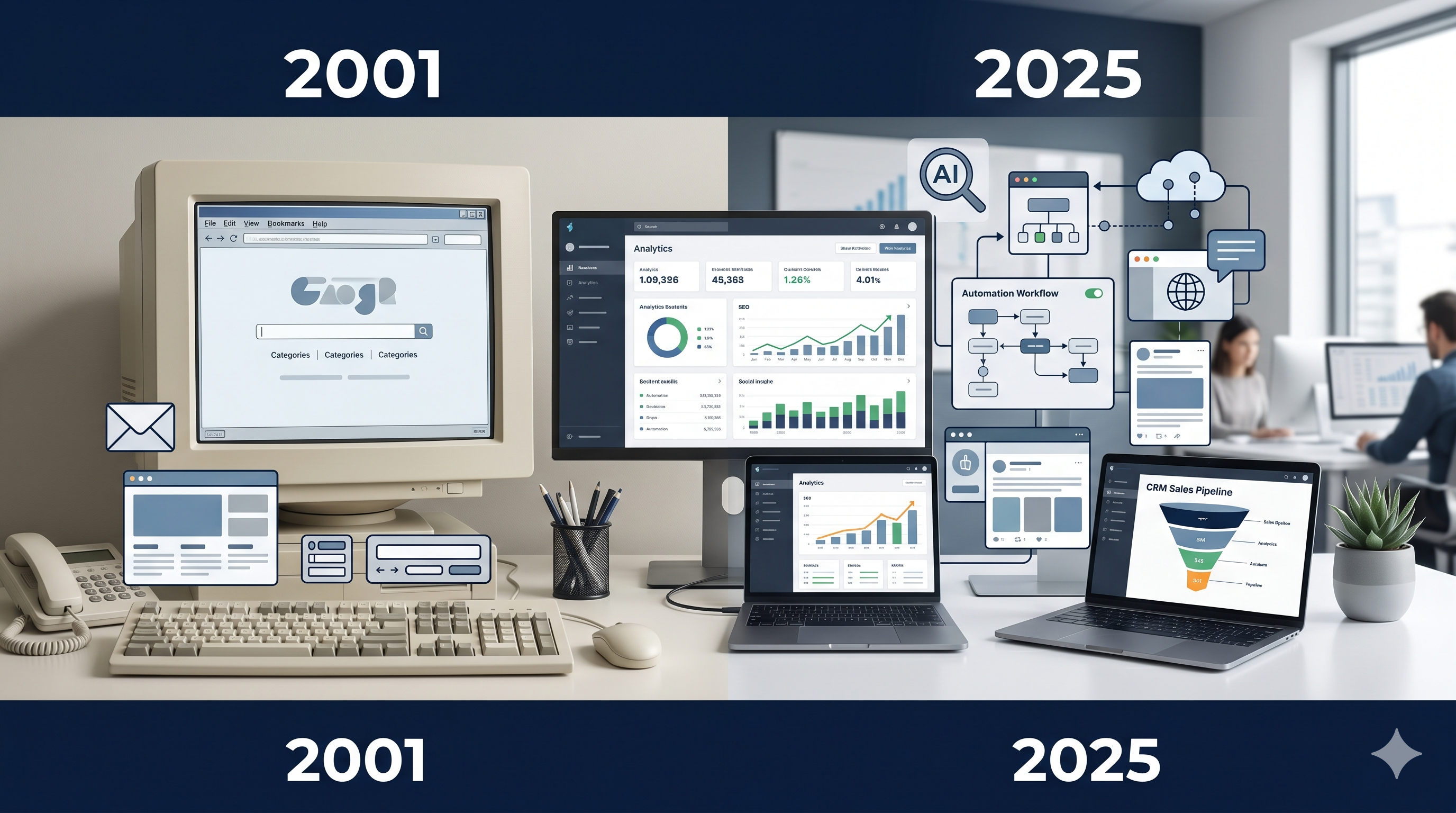
The short version: Digital marketing has changed dramatically from 2001 to 2025, but the core job remains the same: help the right people find you, build trust, and make the next step obvious.
The Tools Changed. The Fundamentals Did Not.
Digital marketing has changed almost beyond recognition over the last 25 years.
In 2001, getting a business online was already a big step. A basic website, a few keywords, some directory listings, maybe a banner ad or an email newsletter if you were feeling advanced. Many business owners were still asking why they needed a website at all.
By 2025, the landscape looked completely different. Businesses were dealing with AI search, Google algorithm updates, short-form video, paid advertising, marketing automation, CRM integrations, first-party data, content strategy, analytics, conversion tracking, and customers who expected answers almost instantly.
It is a lot. But here is the interesting part: the core job of digital marketing has not changed.
In 2001, businesses wanted to be found, trusted, and chosen. In 2025, businesses still wanted to be found, trusted, and chosen.
What Digital Marketing Looked Like in 2001
Digital marketing in 2001 was a much simpler world, at least on the surface.
A business website was often little more than an online brochure. It had a home page, an about page, a services page, contact details, and maybe a few awkward stock images. If the business had a website at all, they were already ahead of many competitors.
Search engine optimisation was also very different. SEO in the early 2000s often focused on keywords, meta tags, basic on-page content, directory submissions, and getting links wherever you could. Search engines were not as sophisticated as they are today, and many tactics that worked then would be dangerous now.
Social media marketing was not yet the dominant force it became later. Facebook had not launched. LinkedIn was still around the corner. YouTube did not exist yet. TikTok was not even a thought.
Email marketing existed, but automation, segmentation, behavioural triggers, and personalised customer journeys were not standard practice for most small and medium-sized businesses.
In short, digital marketing in 2001 was mostly about getting online and becoming visible. For many businesses, that alone was progress.
What Digital Marketing Looked Like by 2025
By 2025, digital marketing had become far more complex.
A website was no longer enough on its own. Businesses needed fast websites, mobile-friendly design, technical SEO, useful content, analytics, tracking, conversion optimisation, paid campaigns, social media, email systems, CRM tools, automation, and increasingly, AI-assisted workflows.
Search had also changed dramatically. Google was no longer just matching keywords. Search engines were trying to understand intent, authority, usefulness, experience, trust, and context. AI-powered search experiences made this even more interesting, because people were no longer only typing short keywords into a search bar. They were asking full questions and expecting useful answers.
Social media had become a serious business channel, but also a noisy one. Organic reach was harder. Paid campaigns were more competitive. Short-form video became a major attention driver.
At the same time, customers became more informed and less patient. They could compare providers quickly, read reviews, ask AI tools for recommendations, and check your website, LinkedIn page, Google Business Profile, case studies, and competitors before ever speaking to you.
By 2025, digital marketing was no longer just about being online. It was about being useful, visible, credible, and easy to choose.
The Biggest Changes Over 25 Years
The last 25 years brought massive changes to the digital marketing world.
Search became strategic
In the early days, SEO could be fairly mechanical. Add keywords. Build links. Submit pages. Hope for rankings. By 2025, SEO had become much more strategic. Technical performance, content quality, search intent, authority, and user experience all mattered.
Social media became a marketing ecosystem
What started as a way for people to connect became one of the biggest marketing ecosystems in the world. Businesses had to learn how to communicate in public, respond faster, build community, handle criticism, and create content that felt native to each platform.
Data became available everywhere
In 2001, many businesses had very limited visibility into what was working. By 2025, there were dashboards for almost everything: website traffic, conversion rates, email open rates, ad performance, lead sources, customer journeys, and sales attribution.
Automation connected the customer journey
Leads could move from a website form into a CRM, trigger an email sequence, notify a salesperson, update a pipeline, and feed reporting dashboards. Done properly, this saved time and improved follow-up. Done badly, it created a very expensive mess.
AI became part of daily marketing work
By 2025, AI supported content planning, research, campaign ideas, customer support, reporting, SEO analysis, workflow automation, and creative testing. But AI did not remove the need for strategy. If anything, it made strategy more important.
What Has Not Changed
For all the change, the fundamentals of digital marketing are surprisingly stable.
- A business still needs to know who it is trying to reach.
- It still needs to explain what it does clearly.
- It still needs to build trust.
- It still needs to show why it is a better choice.
- It still needs to make the next step easy.
These basics sound simple, but they are where many businesses still struggle.
They invest in ads before fixing their offer. They post on social media without knowing who they are talking to. They create content that sounds impressive but does not answer real customer questions. They install CRM systems without a clear sales process. They use AI tools to produce more content, but not necessarily better content.
That is the trap. Digital marketing has become more advanced, but the basics still matter. In fact, because the online world is noisier than ever, the basics matter more.
Why Businesses Still Chase Tools Before Strategy
One of the biggest problems in digital marketing is the constant temptation to chase the newest tool.
A new platform appears. A new AI tool launches. A new tactic gets attention. Suddenly everyone wants to know whether they should be doing it.
Sometimes the answer is yes. Often, the better answer is: not yet.
Not because the tool is bad, but because the foundation is weak.
- If your positioning is unclear, a new tool will not fix it.
- If your website does not explain what you do, more traffic will not solve the problem.
- If your sales process is broken, more leads may just create more frustration.
- If your content does not help your ideal customer, publishing more of it will not magically build trust.
Strategy comes first. Tools support the strategy. They do not replace it.
What Businesses Needed to Focus On by 2025
By 2025, effective digital marketing required a more connected approach.
Businesses needed a website that worked properly, loaded quickly, and explained their value clearly. They needed SEO that went beyond keywords and focused on useful content, search intent, technical health, and authority. They needed content that answered real questions, supported the sales process, and helped customers make better decisions.
They also needed social media that matched the platform and audience, email and CRM systems that managed relationships instead of just sending more noise, analytics that measured meaningful actions rather than vanity metrics, and AI or automation that improved efficiency without losing the human thinking behind the work.
That last part matters. AI can help you move faster. It can help you research, draft, organise, analyse, and automate. But it cannot decide what your business should stand for. It cannot replace real customer understanding. It cannot fix a weak offer. It cannot build trust if the substance is not there.
The Role of SEO in 2001 vs 2025
SEO is one of the clearest examples of how much digital marketing changed.
In 2001, SEO was often treated as a technical trick. Get the right keywords onto the page. Add meta tags. Build links. Repeat.
By 2025, SEO had become much closer to business strategy. Good SEO required understanding what customers were searching for, why they were searching, what questions they needed answered, and what would help them take the next step.
It also required technical discipline. Pages needed to load quickly. Websites needed to work properly on mobile. Content needed structure. Internal linking mattered. Schema markup could help search engines understand content. Tracking and analytics needed to be in place.
SEO also became more closely connected to trust. Search engines increasingly rewarded content that demonstrated experience, expertise, authority, and credibility. Businesses could no longer rely only on keyword placement. They had to show that they knew what they were talking about.
That is a good thing. Because in the end, SEO should not just be about rankings. It should be about helping the right people find the right information at the right time.
AI Search and the Next Stage of Digital Marketing
AI search has added another layer to digital marketing.
People are no longer only searching in the old way. They ask longer questions. They expect summaries. They use AI tools to compare options, understand problems, and make decisions.
This means businesses need to think differently about content. It is not enough to publish thin articles stuffed with keywords. Content needs to be clear, useful, well-structured, and credible. It needs to answer real questions. It needs to show expertise. It needs to help both humans and search systems understand what the business does and why it matters.
This does not mean traditional SEO is dead. That line has been used far too many times. It means SEO is evolving again.
The businesses that do well will be the ones that combine strong fundamentals with the newer realities of AI-assisted discovery.
What Businesses Should Take From 25 Years of Digital Marketing
The biggest lesson from 2001 to 2025 is not that businesses need to be everywhere. They do not.
The lesson is that businesses need to be clear, useful, visible, and consistent.
You do not need every platform. You do not need every tool. You do not need to chase every trend.
You need to understand your customer, explain your value, build trust, and make it easy for people to take the next step. Then you choose the tools that support that.
That might include SEO, paid ads, social media, email marketing, CRM systems, automation, AI tools, video content, or all of the above. But the tools should serve the strategy, not the other way around.
Final Thoughts
Digital marketing between 2001 and 2025 changed completely. Websites became more advanced. Search became smarter. Social media became louder. Paid media became more competitive. Data became more available. Automation became more powerful. AI changed how we work and how customers search.
But the job is still the same.
Help the right people find you. Give them a reason to trust you. Make the next step obvious.
That was true in 2001. It was still true in 2025. And it will probably still be true no matter what the next platform, algorithm, or AI tool decides to throw at us.
Related OPC Resources
Want the tools connected to a real strategy?
Omni Process Consulting helps local service businesses turn websites, SEO, ads, CRM, AI, and follow-up into one practical lead system.
Request a Free Lead System Audit