
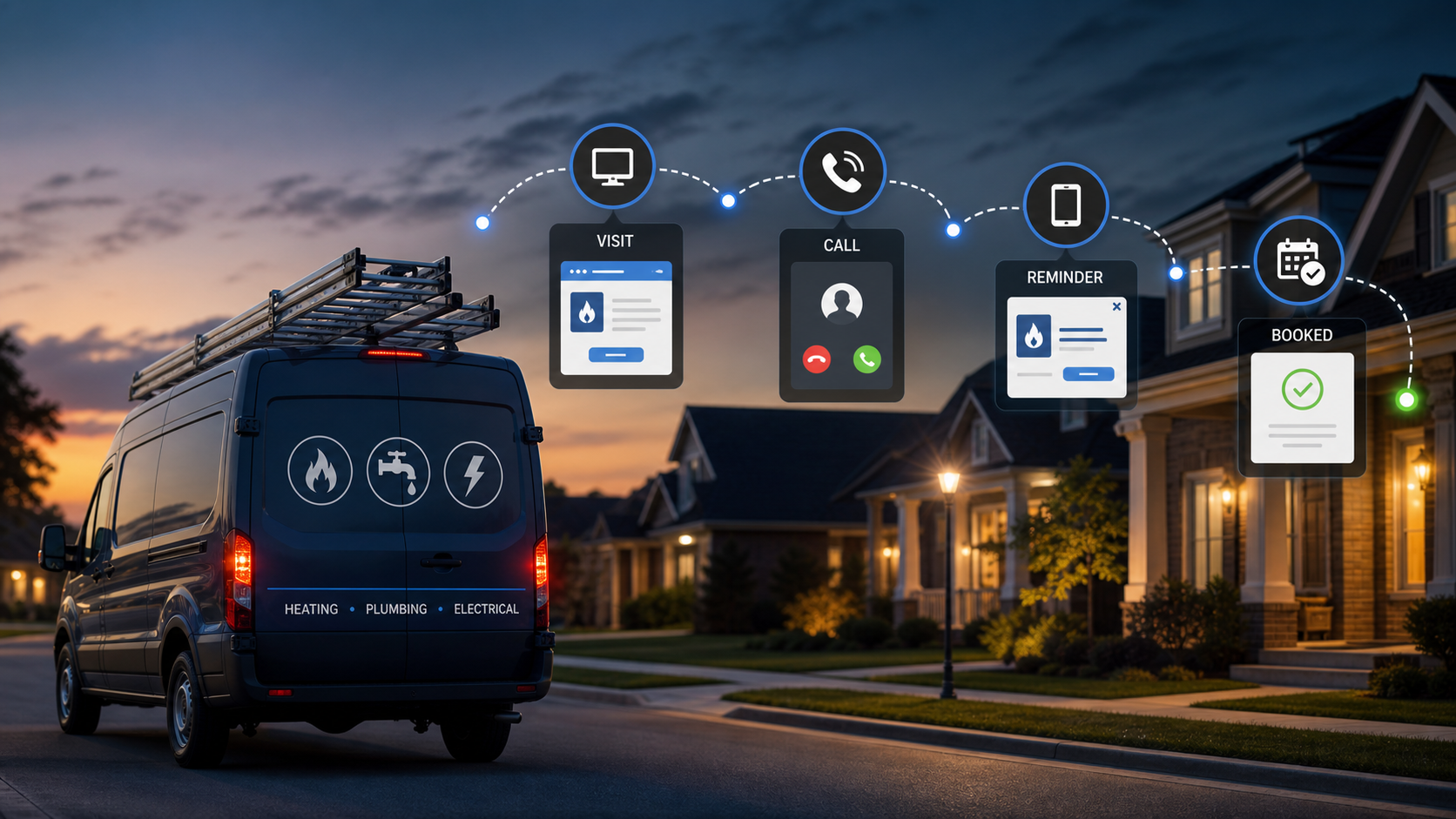
The short version: Retargeting helps HVAC, plumbing, electrical, roofing, and other local service businesses get more value from people who already visited, clicked, watched, or engaged but did not call the first time.
Why Most Local Service Leads Are Not Ready the First Time They Visit Your Website
Most local service businesses think of marketing in a straight line.
Someone searches on Google. They click the website. They call. They book.
That does happen, but it is not the whole story.
A homeowner looking for HVAC repair, plumbing help, electrical work, roofing, cleaning, or emergency service may visit several websites before calling anyone. They may check reviews, compare companies, ask a spouse, get distracted, or decide the problem can wait until tomorrow.
The issue is simple: if they leave your website without calling, most local businesses have no way to stay in front of them.
That is where retargeting becomes valuable.
What Retargeting Actually Is
Retargeting is a digital advertising strategy that shows ads to people who have already visited your website or interacted with your business online.
Google refers to these as data segments, which can include website visitors or app users collected through the Google tag. Meta allows businesses to create Custom Audiences from website visitors, Facebook page engagement, customer lists, and other interactions.
In plain English: if someone visits your HVAC repair page but does not call, you can later show them an ad reminding them that your company handles heating and cooling repairs.
Retargeting is not magic. It does not force people to become customers. What it does is keep your business visible after the first visit.
Why Retargeting Is So Important for Service Businesses
Local service marketing is competitive because the customer often has urgent intent.
When a homeowner has no heat, no cooling, a water leak, a tripped breaker, storm damage, or a blocked drain, they do not calmly research for weeks. They search, compare, and call quickly.
But quickly does not always mean instantly.
A customer may open five tabs. They may click a Google Business Profile, then a website, then a competitor, then a review page. If your business disappears after that first visit, you are depending on them to remember you.
Most will not.
Retargeting solves three major problems:
- It keeps your name visible after the first visit.
- It gives undecided customers another reason to come back.
- It makes your other marketing work harder.
Retargeting Is Not Just for Big Companies
A lot of small business owners assume retargeting is only for eCommerce brands or large companies with big ad budgets.
That is not true.
Retargeting can be especially useful for owner-operated service businesses because the audience is warmer than cold traffic. These people have already shown some level of interest.
They may have searched for AC repair, furnace repair, emergency plumber, electrician near me, roof leak repair, storm damage contractor, drain cleaning, HVAC maintenance, or heating repair near me.
If they reached your site from one of those searches, that visit has value. Letting that visitor disappear completely is a missed opportunity.
The Big Mistake: Running Google Ads Without Retargeting
Many local companies run Google Ads only for direct search traffic.
That means they pay for a click, send the person to a website, and hope the visitor calls. If the person does not call, the business owner often assumes the click was wasted.
Sometimes it was. But sometimes the visitor was a real prospect who was not ready yet.
A retargeting system gives that visitor a second path back with messages such as:
- Still need AC repair?
- Missed the office? Request a callback for HVAC service.
- Emergency heating and cooling support for local homeowners.
That second touch can be the difference between a lost visitor and a booked call.
Why Retargeting Works Well With Local SEO
SEO often brings in research-stage traffic.
Someone may read a blog post about why their furnace keeps shutting off. Another person may check whether an emergency repair company serves their neighborhood. Another may compare local roof repair options after a storm.
Not every visitor is ready to convert immediately.
Retargeting lets your business stay visible after the SEO visit. This is why retargeting and SEO should not be treated as separate efforts. They support each other.
- SEO gets people to the site.
- Retargeting brings some of them back.
- A strong landing page converts them.
- Tracking tells you what worked.
Good Retargeting Is Based on Intent
The best retargeting is not one generic ad shown to everyone. A better system groups visitors based on what they looked at.
For a local service company, useful audience groups might include:
- All website visitors
- Visitors to HVAC repair pages
- Visitors to emergency service pages
- Visitors to financing pages
- Visitors who clicked a phone number
- Visitors who submitted a form
- Visitors who viewed service-area pages
- Visitors who read after-hours or missed-call content
The more specific the audience, the more relevant the message can be. Intent matters.
What a Basic Retargeting Setup Should Include
A practical retargeting setup for a local service business usually includes four parts.
1. Tracking Tags
At minimum, the website should have Google Tag Manager, GA4 tracking, Google Ads conversion tracking if running Google Ads, Meta Pixel if running Facebook or Instagram ads, and event tracking for phone clicks, form submissions, email clicks, and key calls-to-action.
A pageview is not a lead. A phone click is closer to a lead. A form submission is a lead. A booked appointment is even better.
2. Audiences
Once tracking is in place, you need audiences such as website visitors in the last 30 or 90 days, service page visitors, blog readers, visitors who did not submit a form, returning visitors, and visitors who clicked a CTA but did not convert.
3. Retargeting Ads
The ads should be simple and specific. Good messages include: still need help with your repair, request a callback today, emergency service available, local team serving your area, need a second opinion, or missed us earlier.
4. Conversion Tracking
You need to know whether the retargeting campaign produced calls, forms, emails, booking clicks, quote requests, AI assistant interactions, or booked jobs.
Retargeting for HVAC Companies
HVAC is one of the best fits for retargeting because timing matters.
A homeowner may ignore a weak AC system until the first hot week. They may delay furnace repairs until the temperature drops. They may compare several companies before booking a maintenance visit.
Useful HVAC retargeting audiences include AC repair page visitors, furnace repair page visitors, emergency HVAC visitors, maintenance plan visitors, financing page visitors, visitors from Google Ads, and visitors who landed on city-specific HVAC pages.
Useful HVAC messages include:
- Still need AC repair?
- Book heating service before the next cold snap.
- Get your HVAC issue checked before it becomes an emergency.
- Missed our team? Request a callback.
Related OPC pages: HVAC Retargeting in Houston, HVAC Retargeting in Buffalo, and Google Ads for HVAC Companies in Buffalo.
Retargeting for Plumbers, Electricians and Roof Repair Companies
The same principle applies across other service trades.
For plumbers, retargeting can support drain cleaning, leak repair, water heater replacement, emergency calls, and sewer inspections.
For electricians, it can support panel upgrades, emergency electrical repair, generator installation, EV charger installation, and safety inspections.
For roof repair companies, it can support storm damage, leak repair, emergency tarping, roof inspections, and insurance-related follow-up.
These are not casual purchases. The customer may need trust before they call. Retargeting helps build that familiarity.
What Retargeting Should Not Do
Retargeting should be practical and compliant.
It should not use creepy messaging like: we saw you looking at our website. It should not make sensitive personal claims. It should not send personal data into ad platforms through tracking tags.
Google's personalized advertising policies place limits on how user data can be used, especially around sensitive categories and personally identifiable information. Local service businesses should keep retargeting focused on general service interest, not personal circumstances.
A better message is: Need help with HVAC repair? Not: We know your AC is broken.
How Much Should a Local Service Business Spend on Retargeting?
Retargeting usually does not need the same budget as cold lead generation.
For many small local service businesses, even a modest monthly budget can keep the company visible to recent website visitors.
The right budget depends on website traffic volume, service area size, seasonality, average job value, emergency vs non-emergency services, and existing Google Ads or Meta Ads spend.
A company with very little traffic may need to build search or social traffic first. A company already getting steady website visits should usually have retargeting in place.
The Simple Retargeting Framework
A basic service-business retargeting system can be built like this:
- Install Google Tag Manager.
- Add GA4, Google Ads, and Meta tracking.
- Track lead actions, not just pageviews.
- Build audiences from website visitors.
- Segment by service interest where possible.
- Create simple ads that remind people to call, request help, or book.
- Exclude people who already converted where appropriate.
- Review results monthly.
- Improve landing pages based on user behavior.
- Connect tracking to actual leads and booked jobs.
Why Many Local Businesses Need Help With This
Most local service business owners do not have a retargeting problem because they are lazy.
They have a retargeting problem because the setup touches too many systems: website, Google Tag Manager, GA4, Google Ads, Meta Ads, conversion tracking, call tracking, forms, CRM or lead follow-up, landing pages, privacy, and consent settings.
One missed tag, one broken form event, or one poorly built audience can make the whole system unreliable.
That is why retargeting should be treated as part of a lead system, not just an ad campaign.
Final Thought
Retargeting matters because most local service leads do not move in a perfect straight line.
They search. They compare. They leave. They come back. They ask someone else. They wait until the problem gets worse.
If your business has no retargeting system, you are relying on the customer to remember you.
A better approach is to build a simple system that keeps your business visible, tracks real lead actions, and brings warm visitors back when they are ready to act.
For HVAC, plumbing, electrical, roofing, cleaning, landscaping, and other local service businesses, retargeting is not a luxury. It is one of the most practical ways to get more value from the traffic you already worked hard to earn.
Related OPC Resources
Sources
Want retargeting connected to real lead tracking?
Omni Process Consulting helps local service businesses connect SEO, ads, retargeting, forms, call tracking, CRM, AI lead handling, and follow-up into one practical system.
Request a Free Lead System Audit